
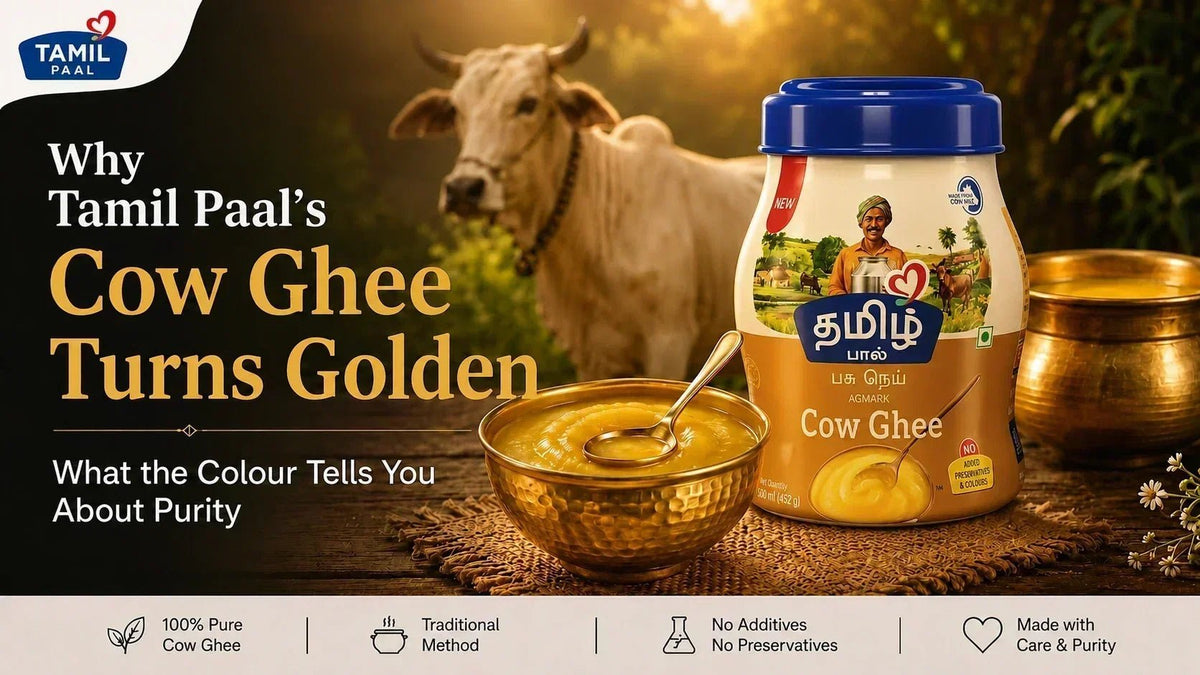
You know that one spoonful of real cow ghee is glowing golden, but some jars are just grey and pale, right? Well, that colour is not the result of playing with colours. Pure cow ghee gets its natural golden colour from pigments in cow milk. In fact, it's one of the easiest ways to know your homemade ghee is genuinely pure or heavily processed. This article discusses the science behind the colour, what the colour tells, and how to identify a real A2 cow ghee before purchasing it.
What Gives Cow Ghee Its Natural Golden Colour?

Cow ghee gets its colour from a plant-derived pigment called beta-carotene, which the livestock take from the fresh grass and feed that they consume. When beta-carotene gets introduced to milkfat and the fat is slow-cooked through the time-honoured traditional method of ghee making, the pigment doesn't get destroyed and the ghee becomes a pretty warm yellow-gold shade. That explains why ghee is yellow.
This colour is influenced by three factors:
A2 cow milk from cows eating grass – the natural source of high beta-carotene.
The traditional method, which makes use of cooking at a low temperature.
Change of diet through every season – leading to slight shade variations of the butter from year to year.
This natural variation is a positive sign, as it indicates that any artificial colour has not been used in the product.
What Does the Colour of Ghee Indicate About Purity?
What ghee's colour tells us about its purity boils down to one point – a more intensely golden colour typically represents higher carotenoid retention, indicating less processing and excellent milk quality. Ghee that's very pale, chalky, or unnaturally white is often the result of excessive refining, bleaching, or being mixed with cheaper fats.
|
Aspect |
Pure Ghee |
Adulterated/Over-processed Ghee |
|
Colour |
Warm yellow to golden |
Pale, white, or unnaturally uniform |
|
Aroma |
Rich, nutty, slightly sweet |
Flat, neutral, or artificial |
|
Texture |
Soft, granular |
Waxy or greasy |
|
Melting |
Melts smoothly near body temperature |
Melts unevenly or stays oily |
If your ghee ticks the right column more than the left, it's worth questioning what's actually in the jar.
Vitamin A and Nutritional Benefits Behind the Golden Shade
It is the very same beta-carotene colouring the ghee (clarified butter) that also gives vitamin A in ghee. Vitamin A is one of the vitamins that eyes, the immune system, and skin repair, respectively, all have in common. Apart from this, health fats in ghee also play a role in gut health.
Cow ghee, the nutritional benefits of the golden variety commonly known, are
Boosts immunity and vitamin absorption
Helps digestion if taken in reasonable amounts
Improves skin and eye health
Supplies energy via fat, easy to digest
These are the benefits known well in the Ayurveda system and also confirmed by modern nutrition, but ghee should be eaten not more than a balanced diet allows.
Benefits of Golden Ghee vs Pale/White Ghee
Golden ghee usually keeps more of the naturally occurring nutrients and original taste than the pale, super-processed types. The golden ghee has a stronger natural scent, better absorption by the body, a richer taste for cooking, and a higher level of fat-soluble nutrients as its advantages. The pale ghee, then again, may indicate that these characteristics have been removed through aggressive refining.
How to Identify Pure Ghee at Home
Here are some tricks to identify pure ghee without any lab equipment:
1. Palm test: Heat a little ghee in your hand. Pure ghee melts very quickly in your hand due to body heat.
2. Smell test: Sequentially, warm a spoonful of ghee. It should release a sweet and nutty smell. A flat, cheap smell indicates impurities.
3. Boiling test: Heat a spoonful of ghee in the pan. Pure ghee will melt quickly and smell sweet, while mixed adulterated ghee will take a longer time to melt and smell bad.
Watch for warning signs like no aroma even when warmed, a uniformly pale colour, or a waxy, sticky texture.
Why Tamil Paal's A2 Cow Ghee Turns Golden

Tamil Paal cow ghee naturally gets its golden colour. Our native cows are free to browse on natural grasses, and the milk is made in the ancient traditional method of making ghee without any shortcuts like high-heat exposure or bleaching.
These are the reasons that our A2 cow ghee from Tamil Nadu displays a natural variation of colours that one would associate with real, small-batch manufacture, sourced from various local farmers, and produced in small quantities, to ensure quality, not quantity.
How to Buy Pure Golden Cow Ghee Online in Tamil Nadu
When purchasing pure golden cow ghee in Tamil Nadu, take note of the following:
The ghee should have a natural golden tint, not an unnaturally uniform pale colour.
The label should mention the use of A2 cow’s milk and the traditional technique for making ghee.
The packaging should show an FSSAI certification.
A slight variation in colour from batch to batch should not be taken as a defect.
Among the best pure cow ghee in Tamil Nadu, Tamil Paal is the most promising brand committed to traditional methods of ghee making.
Frequently Asked Questions
1. Why does cow ghee turn golden yellow?
This is caused by beta-carotene from the cow's natural, grass-fed diet, which has been preserved during traditional, slow-cooked processes.
2. What does the colour of ghee indicate about purity?
Golden colour is usually tied to high leaching and less refining. White or almost white ghee indicates refining or diluting processes.
3. Is golden ghee healthier than white ghee?
Golden ghee maintains more of the original nutrients, like vitamin A and fats, than the overly processed white ghee.
4. Does the colour of ghee change with season?
Yes. Because the diet of cows changes as the seasons change, the level of 'goldenness' may differ from batch to batch.
6. Does Tamil Paal ghee come only through the traditional process?
Definitely. Tamil Paal A2 Cow's Ghee is made by the traditional process with local, grass-fed cattle milk only.
Conclusion
The golden colour of cow ghee is more than visual appeal; it's a window into how the ghee was made and how much of its natural nutrition survived the process. From beta-carotene and vitamin A to the traditional method, every shade tells a story of purity. If you want ghee that's golden for the right reasons, choose Tamil Paal cow ghee, made the traditional way, straight from Tamil Nadu farms. Order your jar of Tamil Paal pure golden cow ghee online today and taste the difference purity makes.
நாட்டு பசும்பால் · Pure A2 Milk
Perfect for Shakes, Sweets, Ghee & Butter
Made with fresh நாட்டு பசும்பால் — richer, creamier, and more delicious for preparing traditional milk sweets, pure ghee, fresh butter, and homemade dairy delights. Experience authentic taste and natural goodness in every recipe.
Shop Now


Leave a comment
This site is protected by hCaptcha and the hCaptcha Privacy Policy and Terms of Service apply.