
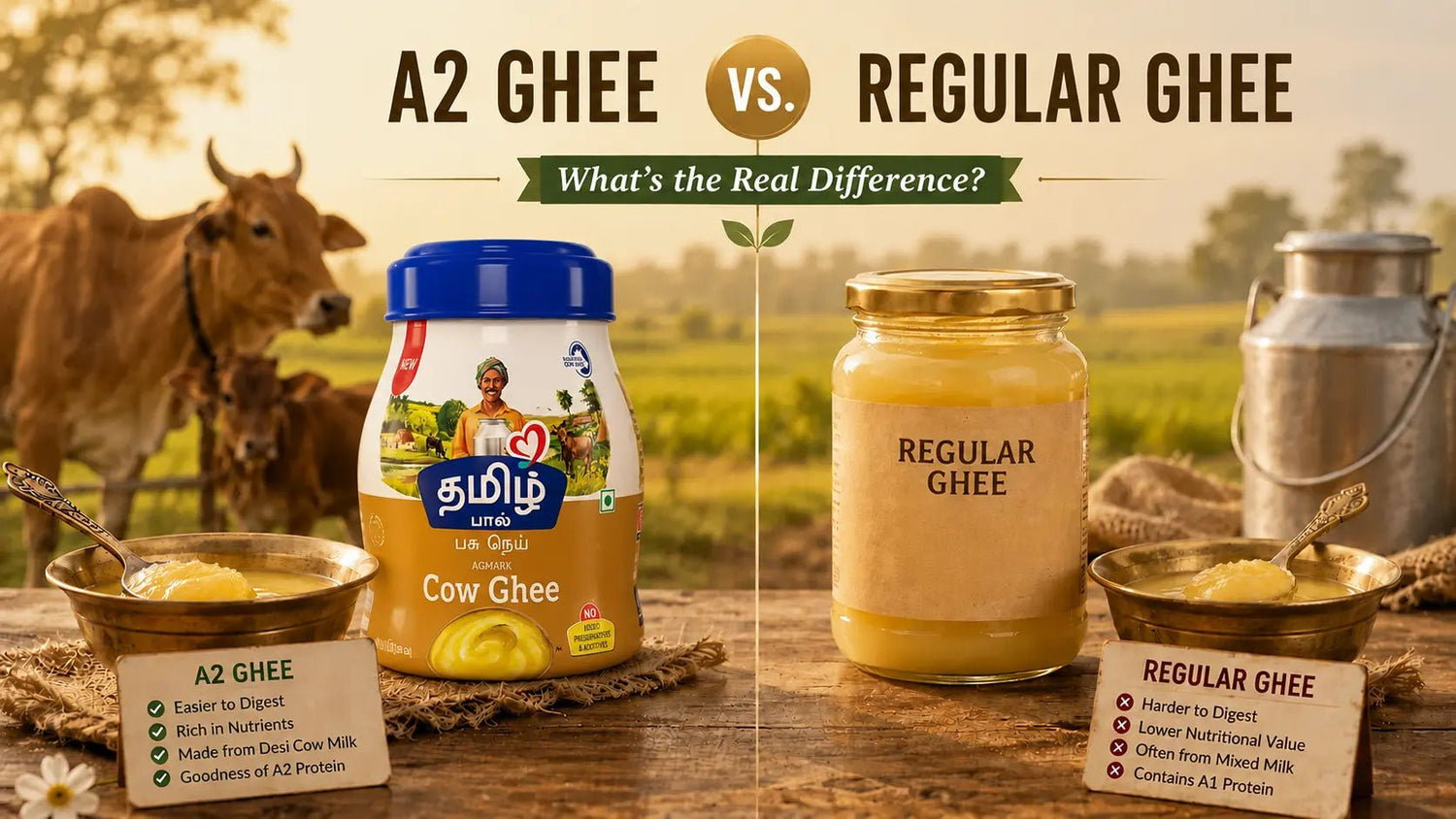
If you have ever spent time staring at a shelf of ghee wondering what the difference is between two jars of ghee, then you’re certainly not the only one. The answer to the question of A2 ghee vs. regular ghee is simple: the type of milk used to make the product, its processing style, and how much nutrition is retained post-processing. Here, at Tamilpaal, people ask us about this fact almost every week.
What Is A2 Ghee?

What is A2 ghee? A2 ghee is produced using the milk of traditional cow breeds that give only A2 beta-casein protein and not the A1 protein of other hybrid cow breeds. This protein is believed to be easier to digest. As the milk is sourced from distinct desi cow ghee breeds, which have been kept separate from hybrids during processing, A2 ghee offers better analytics and distinctness than ghee produced in bulk.
What Is Regular Ghee?
Generally, the regular ghee comes from milk of different cows, and after obtaining the cream from the milk, it is manufactured using modern techniques at fast and mass-level rates. There is no tracking of breeds, as it is volume that the industry is after rather than precision in sourcing. It is a convenient option for cooking, but if you look at pure cow ghee vs. regular ghee, the regular ghee falls short with its health benefits and cultural significance.
A2 Ghee vs. Regular Ghee: Key Differences
|
Factor |
A2 Ghee |
Regular Ghee |
|
Milk Source |
Indigenous cowbreeds |
Mixed/crossbred cattle |
|
Protein Type |
A2 beta-casein |
Mostly A1 beta-casein |
|
Production |
Bilona (hand-churned) |
Industrial cream separation |
|
Nutrient Retention |
High (slow-cooked) |
Moderate (fast processing) |
|
Taste & Texture |
Grainy, aromatic |
Smoother, milder |
|
Price |
Higher |
Lower |
This table sums up desi ghee vs. regular ghee at a glance—sourcing and process are what really separate the two.
How Traditional A2 Ghee Is Made
Deliberately, the process happens slowly—milk is curdled, manually churned to produce butter, and simmered in small amounts of ghee. This consistently consumes a whole day rather than a few hours. With slow preparation, the process is able to preserve the flavor and natural qualities that quicker methods can’t guarantee. TamilPaal sources its milk from over 14,000 farmers in Delta, which ensures the quality control consistency of tradition.
A2 Ghee Benefits Over Regular Ghee.

Are you curious if A2 ghee is healthier than regular ghee? Here are some distinctions:
A2 protein is easier to digest than A1 protein.
The natural vitamins such as A, D, and E found in A2 ghee support one's immune system.
Nutrient retention is enhanced by proper cooking approaches.
Joints may benefit from the healthy fat in ghee.
The flavor and aroma of A2 ghee are superior to its industrial counterpart.
Is A2 Ghee Good for Weight Loss?
For those looking at A2 ghee vs. regular ghee to lose weight, A2 ghee has good fats that support satiety, which can assist you with portion control as part of a healthy diet. It won't do the weight-loss thing alone—you need moderation and also physical activity. Most dietitians recommend 1-2 teaspoons a day with meals only, not a special "diet food."
A2 Ghee vs. Regular Ghee for Daily Cooking
So should we use A2 ghee or regular ghee in our daily cooking? If you do your meals with A2 milk ghee or raw, like on rice, rotis, or dal, then A2 ghee is your healthy, tastier everyday choice. Regular ghee can still be just fine for a high-scale commercial kitchen where the cost is more important than a special source. Supposing you feed your family daily with ghee, A2 ghee is usually the better option.
Is A2 Ghee Safe for Babies and Toddlers?
The comparison between A2 ghee and regular ghee for being used for babies and toddlers suggests that A2 ghee is considered easier to digest due to the absence of A1 proteins. Thus, many parents decide to introduce it early on. It must be remembered that each baby is an individual, so consulting a pediatrician before introducing ghee into a baby's diet is a good idea.
How to Identify Pure A2 Ghee
- The label should specify the cow breed or "indigenous cow milk."
- Look for "Bilona" or "hand-churned" mentioned specifically, not just "traditional."
- No preservatives or additives listed
- Grainy texture and a rich, natural aroma when you open the jar
Which Ghee Should You Choose?
If you care about the purity, traceability, and traditional flavor of ghee, A2 ghee is a worthy investment. If you are looking for that real Indian flavor in dishes that you cook at home every day, Tamilpaal pure cow ghee is made from milk sourced directly from Delta farmers we have been farming with for 25 years.
Frequently Asked Questions
1. How does A2 ghee differ from regular ghee?
The former is made using pure breeds of indigenous cows with a2 beta-casein protein and is made via traditional means, while the latter is made using crossbred cows and made using modern means.
2. Is A2 ghee healthier than regular ghee?
Ghee made from A2 milk is normally more easily digestible because of its slow cooking method, but both are healthy sources of fat if taken in moderation.
3. Which type of ghee should be used for everyday cooking?
A2 ghee is more appropriate for everyday cooking and eating raw owing to its taste and nutrition content. Regular ghee can be used for high-temperature commercial cooking.
4. A2 Ghee for Babies & Toddlers - Is It Allowed?
A2 ghee is often more digestible for babies and toddlers, but you should always first talk to your doctor about whether it's suitable for your baby.
5. What are the advantages of A2 ghee?
A2 ghee helps improve digestion, increases immunity due to vitamins A, D, and E, and keeps all its nutritional value intact due to its traditional process. In addition to that, it provides an enhanced flavor compared to regular ghee.
Conclusion
Choosing between A2 ghee vs. regular ghee really comes down to what you value—convenience and cost or purity and tradition. At Tamilpaal, we've spent over 25 years working directly with Delta farmers to bring that same purity to every product we make, including our pure cow ghee. Ready to taste the difference for yourself? Order Tamilpaal's Pure Cow Ghee today and bring home the real, farm-fresh taste your family deserves.
நாட்டு பசும்பால் · Pure A2 Milk
Perfect for Shakes, Sweets, Ghee & Butter
Made with fresh நாட்டு பசும்பால் — richer, creamier, and more delicious for preparing traditional milk sweets, pure ghee, fresh butter, and homemade dairy delights. Experience authentic taste and natural goodness in every recipe.
Shop Now


Leave a comment
This site is protected by hCaptcha and the hCaptcha Privacy Policy and Terms of Service apply.